

A tiny, soot-covered puppy stood defiantly between the iron rails of a bustling train station, his tail wagging with a strange, frantic determination. As commuters hurried past, the dog remained anchored to the spot, his gaze fixed intensely on the shadows beneath a nearby bench.
Concerned for the animal’s life, a bystander called the police. When the officers arrived, their initial curiosity curdled into alarm. The puppy refused to budge, and as they looked closer at what he was guarding, they turned pale.
Once the officers finally managed to wrestle the puppy from the tracks, his only instinct was to dive back toward them. The police had never seen such a young animal possess such singular, suicidal focus.
However, with the morning rush hour looming and the schedules resuming, they couldn’t allow him to risk his life again.

Lilly, an employee at one of the station’s shops, had been watching the scene unfold. While the officers saw a nuisance, she saw a mystery. Why was this frail creature so determined to return to a place of probable death? Driven by an intuition that everyone else had ignored, Lilly stepped in. She knew that if the puppy was this insistent, there had to be a reason—and they should have listened to him sooner.
The presence of strays near the lines was a constant fear for station staff. An animal on the tracks wasn’t just a safety risk; it was a logistical nightmare that could halt the entire network. Usually, after the morning rush, the staff could finally breathe a sigh of relief. But today, a call from a passing train operator changed everything. He reported seeing something moving on the tracks—something small and well-disguised.
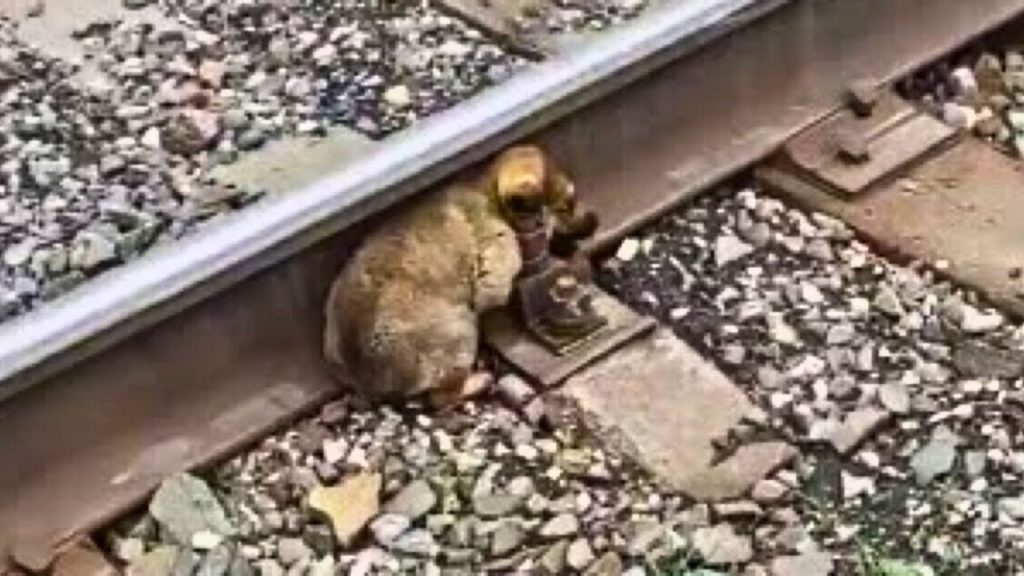
Lilly was the first to spot him. The puppy was so dirty he blended in perfectly with the rusted tracks and oil-stained gravel. He looked weak and malnourished, clearly a product of a hard life on the streets, but his spirit was far from broken.
The station was forced into a total lockdown. No trains could enter until the animal was cleared. For those watching from the platforms, the puppy looked like an easy catch—frail and exhausted. But the dog made fools of the employees. Every time they got close, he outmaneuvered them, dodging nets and hands with desperate agility.

As ten minutes stretched into fifteen, the atmosphere grew tense. Passengers were shouting, and the financial cost of the delay was mounting. With animal control understaffed and an hour away, the police were the only option. When the officers returned with heavy-duty nets and a cage, the struggle intensified. The puppy squealed and thrashed, and even once locked inside the cage, he threw his entire weight against the bars, tipping the metal crate over in his frantic attempt to get back to the rails.
The police were ready to dump the “problem” at a local shelter, but Lilly stepped forward. She told them she would take responsibility for him. In reality, she had no intention of dropping him at a shelter just yet. She needed to know what he was trying to show them.
She moved the puppy to the staff break room. Away from the tracks, his frantic energy faded into a mournful, low howling. Seeing his ribs through his matted fur, Lilly bought him a can of food. For the first time, the puppy seemed happy; his tail wagged, and he inhaled the meal.

As her shift ended at 7:00 PM, Lilly faced a choice. She could go home and take the dog to the shelter, or she could wait until the tracks were clear. Looking into the puppy’s eyes, she saw a plea for help she couldn’t ignore. She spent the next four hours at a nearby restaurant, keeping the dog calm with water and scraps, waiting for the final train of the night to pass.
At 11:00 PM, as the restaurant closed, Lilly led the puppy back to the now-silent station. The moment the scent of the tracks hit him, his composure vanished. As they reached the platform where it all began, the puppy started fighting the cage with renewed, terrifying strength. The truth was waiting somewhere in the dark between the rails, and Lilly was finally ready to find it.
As midnight approached, the station grew quiet. Only a few lingering passengers remained, watching with judgmental eyes as Lilly kept the agitated puppy in his cage. Some whispered that she was being cruel, but Lilly ignored them. She knew the puppy wasn’t acting out of malice, but out of a desperate, hidden purpose.

When the final train finally screeched out of the station and the overhead lights flickered off, leaving the platform in near-darkness, Lilly took a deep breath. She reached down and unlatched the cage.
The puppy bolted. He didn’t run for the exit; he leaped straight back onto the iron tracks. Lilly scrambled after him, her heart hammering against her ribs. In the pitch black of the railyard, she could hear him sniffing frantically. She clicked on her phone’s flashlight, the beam cutting through the gloom.
For a moment, she feared she was too late—that whatever the puppy had been protecting had been scared off or, worse, struck by a train. But the scent was still there, and the puppy was locked onto it. Finally, he stopped. He sat down firmly beside a rail, looking back at Lilly with a low, protective growl.

As she approached, the puppy’s hackles rose. He wasn’t being aggressive; he was standing guard. Lilly peered past him, and the light caught two tiny, reflective eyes. Tucked deep into the crevice of the track was a kitten.
The kitten was no more than a few weeks old, skeletal and shivering. It was too weak to move, likely trapped there for days. The puppy had stayed on those tracks all morning not to play, but to act as a living shield against the thundering trains.
Lilly moved quickly. Despite the puppy’s protests, she managed to get him back into the cage and tucked the frail, crying kitten into the warmth of her coat pocket. She rushed them to an emergency vet, who told her plainly: “If you had waited one more day, the kitten wouldn’t have made it.”
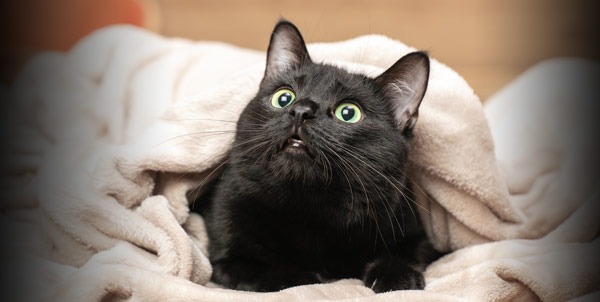
A few days later, the transformation was incredible. Both animals were recovering their strength. The vet spoke of sending them to a shelter for adoption, but Lilly already knew that wasn’t an option. The bond between the brave puppy and his tiny charge was too strong to break—and her bond with them was just as deep. She adopted them both, turning a chaotic day at work into a lifetime of companionship.
The bravery of animals doesn’t end with puppies and kittens. In the quiet countryside, a dog named Kyle was about to prove that retirement doesn’t mean the end of a hero’s journey.
Kyle wasn’t an ordinary pet. He was a retired police canine, a seasoned investigator with a history of solving cases. Though he was a gentle soul who loved his new family, the Smiths, his training had never truly left him. He had been a loyal partner to Officer John, but when John could no longer care for him due to work demands, he entrusted the hero to the Smiths.

Life in the country was a dog’s dream—wide forests and daily hikes. But one morning, the “switch” flipped.
During their usual walk, Kyle’s demeanor changed instantly. He became tense, his nose glued to the damp earth. He ignored his favorite trails, insisting on a path deep into the thicket that the family had never explored.
He stopped eating his treats and remained eerily silent, his tail no longer wagging with joy but stiff with focus. The Smiths tried to lure him back to the main trail, but Kyle’s old police instincts had taken over. He had caught a scent—not of an animal, but of something human. Something hidden.
As Kyle led them deeper into the woods, his movements grew nervous. This wasn’t a game. The retired K9 had detected a trace of something grave, and as the Smiths followed their dog into the shadows of the forest, they realized they were no longer on a walk—they were on a crime scene.
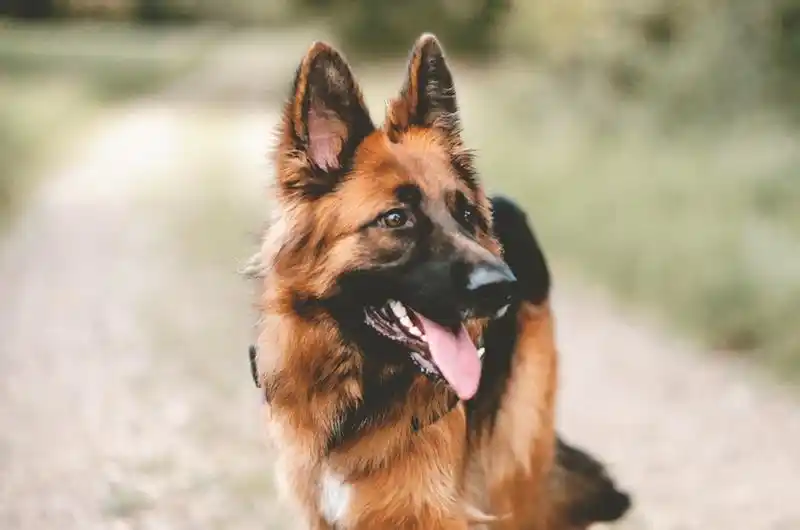
The deeper Kyle led the Smiths into the forest, the more the atmosphere changed. The playful sounds of birds faded, replaced by the heavy silence of a part of the woods that saw no foot traffic. Kyle was no longer sniffing the ground; he was air-scenting now, his head held high and his body trembling with a mix of professional focus and genuine unease.
The family noticed something snagged on a briar bush—a piece of fabric. It was thick, dark, and looked like it belonged to a heavy outdoor jacket. As Kyle lunged toward a particularly dense patch of ferns near a massive, rotting oak tree, he let out a sharp, authoritative bark—his “alert” signal from his days on the force.
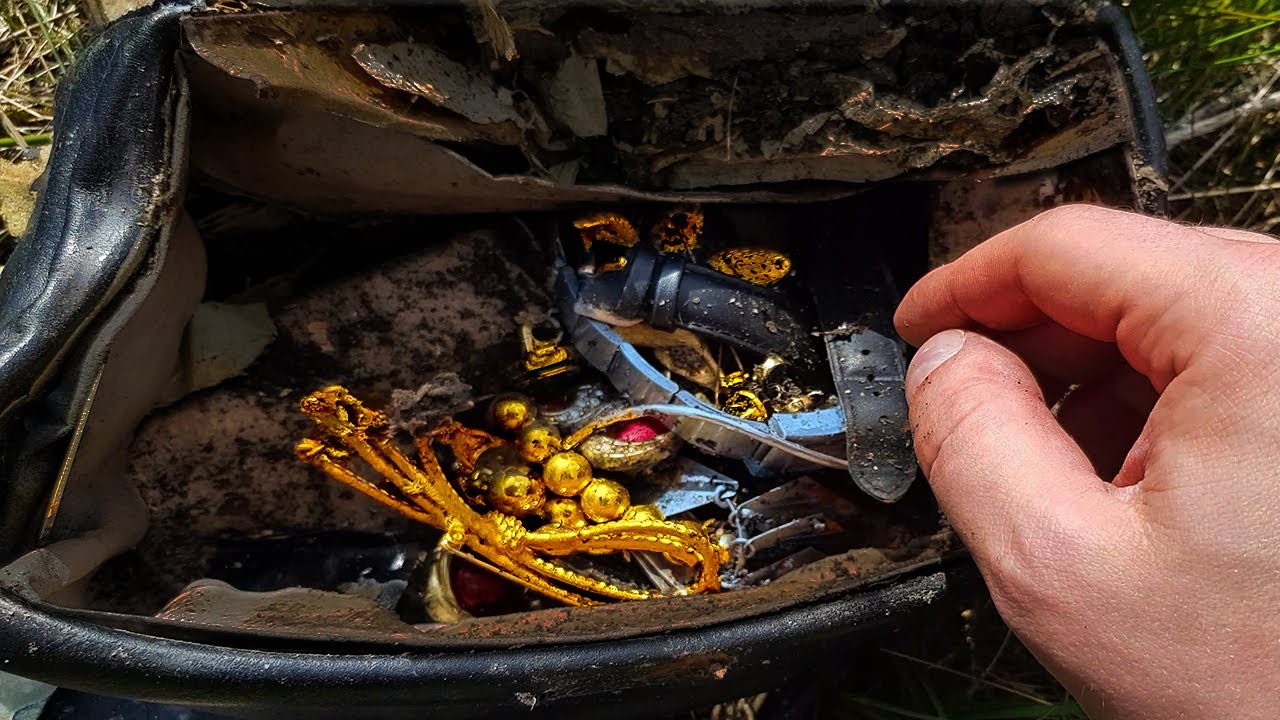
Mr. Smith pushed aside the heavy branches and stopped dead. His face drained of color. Tucked into the hollow of the tree roots, partially covered by a tarp and piles of dead leaves, was a large, heavy duffel bag. But that wasn’t what had made Kyle so nervous.
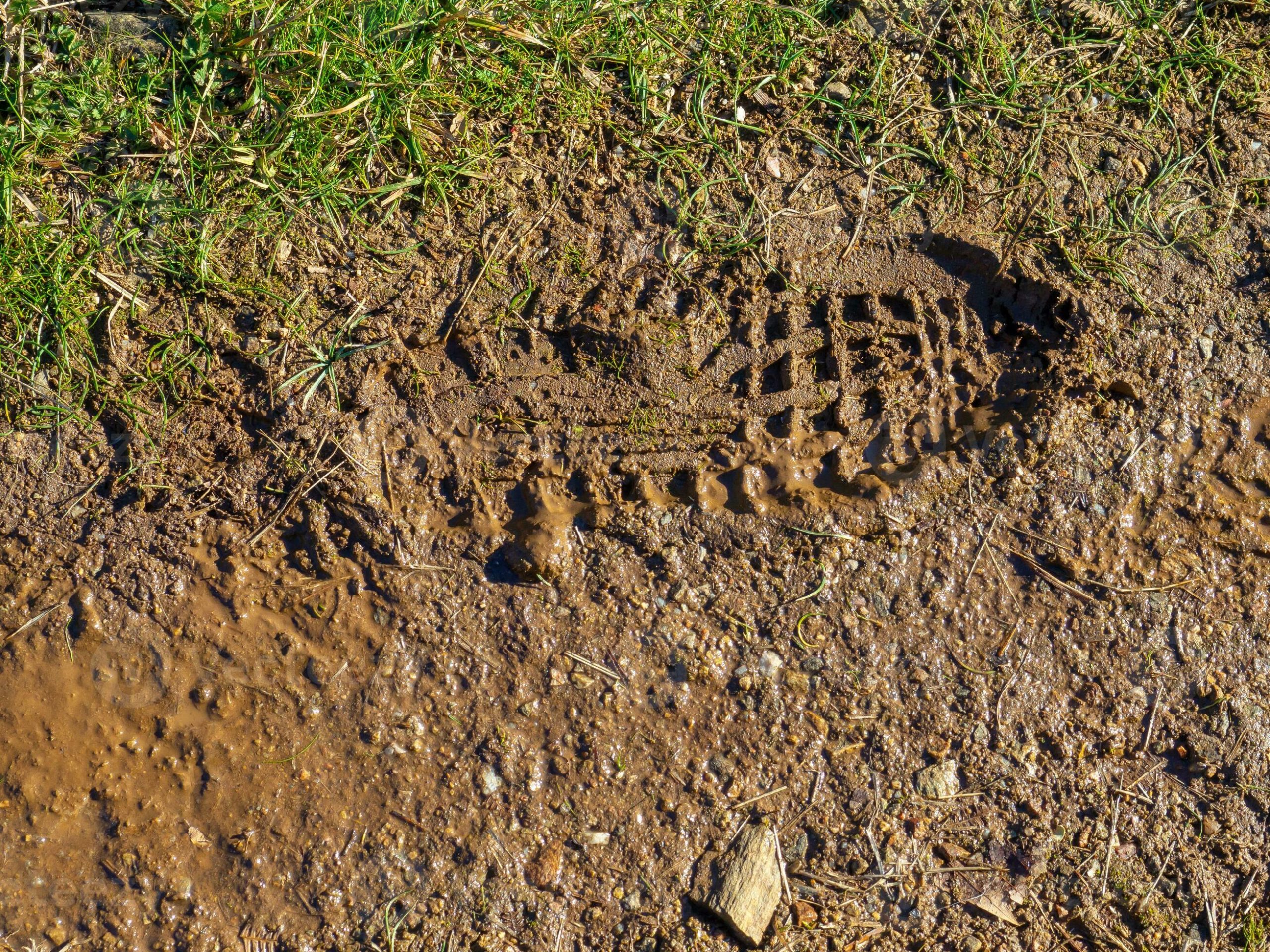
Just a few feet away, hidden in the mud, were fresh boot prints—far too large to be their own. Someone had been here very recently. Kyle stood over the bag, his low growl vibrating in his chest, his eyes scanning the surrounding trees as if he knew the owner of those prints was still watching.
Mr. Smith didn’t open the bag. He knew better. He pulled out his phone, but the signal in the deep woods was nonexistent. They were miles from the house, and Kyle was refusing to leave the spot. The dog’s training was clear: he was protecting the evidence and guarding the perimeter.
“We have to go back,” Mrs. Smith whispered, clutching her coat. “But Kyle won’t move.”
It was then that Kyle’s ears swivelled toward the thicket behind them. He bared his teeth, a sound emerging from his throat that the Smiths had never heard before—a true protector’s roar. Out of the shadows, a figure began to emerge, wearing the same dark, heavy fabric they had seen on the briar bush.

The stranger stopped ten feet away, surprised to see a family out this far. His eyes darted to the duffel bag and then to the dog. He clearly thought he could intimidate the hikers, but he hadn’t accounted for Kyle’s pedigree.
Kyle didn’t wait for a command. He stepped between the stranger and the Smiths, his stance wide and immovable. He wasn’t just a pet anymore; he was a K9 officer on duty. The stranger took one look at the dog’s professional intensity—the way Kyle tracked his every heartbeat—and realized he wasn’t facing a golden retriever.
“Back off!” the man grunted, but his voice lacked conviction.
Kyle’s steady, rhythmic barking echoed through the trees, a sound meant to carry for miles. He was summoning help the only way he knew how. Terrified by the dog’s sheer presence and the realization that the police would soon be looking for a missing family in this area, the stranger turned and bolted into the brush.
The Smiths finally managed to coax Kyle away once the immediate threat was gone. They ran back to the trailhead and immediately called Officer John, Kyle’s old partner.
When the police arrived and Kyle led them back to the oak tree, they discovered that the bag was filled with stolen high-end electronics and jewelry from a string of recent cold-case robberies in the county. Thanks to Kyle’s “outdated” habits and his refusal to ignore a strange scent, a major criminal operation was dismantled.
Officer John visited the Smiths that evening, bringing a giant steak for his old partner. He looked at Kyle, who was now calmly napping at Mrs. Smith’s feet, and smiled.
“I told you,” John said. “A dog like Kyle never really retires. He just changes who he’s protecting.”
Top Articles